
Most freelancers close maybe 15% of the proposals they send. The ones who master the structure below routinely close 60%+. The difference isn't skills—it's learning exactly what clients need to see before they say yes.
A great freelance proposal isn't just a price quote. It's a sales document that proves you understand the problem, demonstrates you can solve it, and makes saying "yes" the obvious next step. The difference between a 15% close rate and a 60% close rate is often just following a proven structure.
This guide gives you the exact proposal template, breaks down what makes proposals win or lose, and shows you real examples from successful freelancers. No guesswork—just a framework that converts. Once the client says yes, follow it with a solid freelance contract, run your client onboarding checklist, and send the deposit invoice with our free invoice generator.
Quick Answer: What Every Winning Proposal Needs
Essential elements (in order):
- Personalized opening — Shows you listened
- Problem summary — Prove you understand their pain
- Your solution — Specific approach, not vague promises
- Deliverables — Exactly what they get
- Timeline — When they get it
- Pricing — Clear options (3 tiers works best)
- Why you — Relevant experience, social proof
- Next steps — Make saying yes easy
What kills proposals:
- Generic "Dear Client" openings
- Talking about yourself before their problem
- Vague deliverables ("quality work")
- Single price (no options)
- No testimonials or portfolio
- Unclear next steps
60%+
Target Close Rate
$2K-8K
Typical Proposal Value
3-7 days
Decision Window
60-70%
Middle Tier Wins
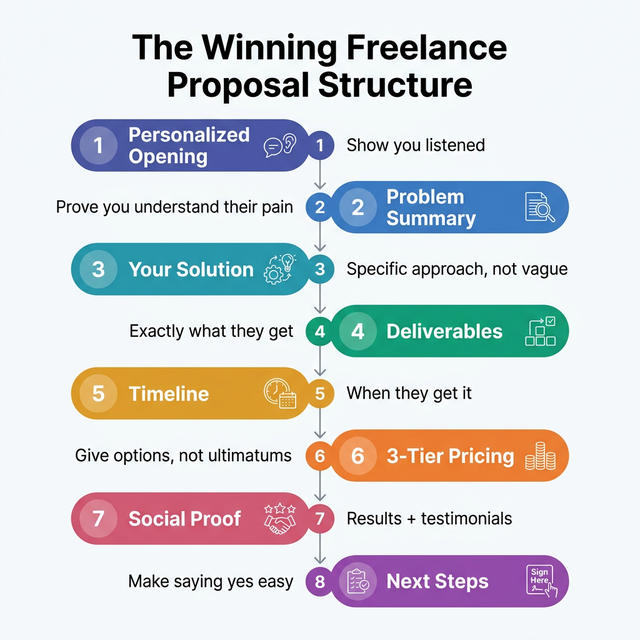
The 8-Section Proposal Structure That Closes 60%+ of Leads
Here is the exact section-by-section breakdown found in winning proposals. Each includes a bad example showing what most freelancers do wrong, and a good example showing what closes deals.
Section 1: Opening: Show You Listened
Bad Example
Dear Hiring Manager,

I am a professional graphic designer with 5 years of experience.
I have worked with many clients and delivered quality work on time.
Good Example
Hi Sarah,

Thanks for sharing your vision for the rebrand—I love that you want to attract premium clients while keeping the approachable vibe that made you successful.

The challenge of "looking more professional without losing personality" is exactly what I solved for [similar client]. Let me show you how we can do the same for your brand.
Why the good version works: Uses their name, references specific conversation details, shows understanding of their challenge, and creates curiosity about the solution.
Section 2: Understanding Their Challenge
Bad Example
I understand you need a new website.

I can make you a great one.
Good Example
CURRENT SITUATION
You currently get leads through referrals, which is great for quality but unpredictable for growth. Your current website is 4 years old and doesn't reflect the premium positioning you're moving toward.

THE PROBLEM
Prospects can't tell from your site that you work with $5M+ companies. They're comparing you to $500 Fiverr designers.

THE GOAL
You need a website that pre-qualifies leads and positions you as the premium option, so prospects arrive ready to pay $8K+.

CONFIRMATION
Did I capture that correctly?
Why the good version works: Shows you listened (they feel heard), frames the problem in their words (builds trust), quantifies the cost (creates urgency), and asks for confirmation (collaborative, not presumptuous).
Section 3: Your Approach & Solution
Bad Example
I will design your website using best practices.
It will look great and be mobile-friendly.
Good Example
HIGH-LEVEL STRATEGY
My approach is to position you as the "premium automation partner" through authority-driven messaging that speaks directly to $10M+ e-commerce brands.

PROCESS OVERVIEW
Phase 1: Strategy & Research (Week 1)
- Competitor analysis of 5 top agencies
- Interview with you and 2 past clients

Phase 2: Homepage & Service Pages (Weeks 2-3)
- Homepage copy (1,200 words)
- 3 service pages (800 words each)

Phase 3: Case Studies & Polish (Week 4)
- 2 case studies (1,000 words each)
- Final revisions + SEO optimization
Why the good version works: Demonstrates strategic thinking (not just execution), provides clear phases so they know what to expect, tailors reasoning to their specific situation, and includes social proof from a similar client.
Section 4: Deliverables (Be Specific)
Bad Example
I will design a professional logo for your brand.
Good Example
WHAT YOU'LL RECEIVE

☐ Primary Logo Design
  - 3 initial concepts, 2 revision rounds
  - Vector (AI, EPS, SVG) and raster (PNG, JPG)
  - Full-color, black, white, reversed versions

☐ Brand Style Guide (12-page PDF)
  - Color palette with HEX/RGB/CMYK codes
  - Typography system with usage guidelines

WHAT'S NOT INCLUDED:
✗ Website design or development
✗ Marketing collateral (brochures, flyers)
✗ Printing services

REVISIONS: 2 rounds for logo, 1 for other items.
Additional revisions: $200/round.
Why the good version works: Checkboxes make it scannable, formats specified prevent confusion, 'Not included' prevents scope creep, and revision limits are clear upfront.
Section 5: Timeline & Process
Bad Example
The project will take approximately 4-6 weeks.
Good Example
PROJECT TIMELINE
Start Date: March 15, 2026 (upon deposit)
End Date: April 26, 2026 | Total: 6 weeks

Week 1-2: Design & Content Structure
- Sitemap, wireframes, homepage mockup
- Deliverable: Full design mockup in Figma

Week 3-4: Development
- Homepage + internal pages build
- Deliverable: Staging site for review

Week 5-6: Launch & Training
- Testing, DNS config, 1hr training session
- Deliverable: Live site + training recording

YOUR RESPONSIBILITIES:
• Provide all content by March 22
• Respond to approvals within 3 business days

Delays in feedback extend the timeline accordingly.
Why the good version works: Specific dates (not vague '4-6 weeks'), clear milestones showing what to expect when, client responsibilities stated upfront, and a flexibility clause protecting you from client delays.
Section 6: Investment & Payment (3 Tiers)
Bad Example
Total cost: $3,000.

Payment due upon completion.
Good Example
ESSENTIAL PACKAGE — $2,400
• Homepage + about page + 1 service page
• 2 revision rounds | 3-week timeline
Best For: Startups validating messaging

RECOMMENDED PACKAGE ⭐ — $4,200
Everything in Essential, plus:
• 2 additional service pages
• Email welcome sequence (3 emails)
• SEO keyword optimization
Best For: Established businesses

PREMIUM PACKAGE — $7,500
Everything in Recommended, plus:
• 2 fully written case studies
• 10 blog post outlines
• Unlimited revisions for 30 days
Best For: Companies with launch deadlines

PAYMENT: 50% deposit | 30% midpoint | 20% final
Why the good version works: Gives clients control (not take-it-or-leave-it), middle option looks like best value (most choose it), high tier makes middle seem reasonable, and average sale price increases vs a single price.
Section 7: Why Me (Social Proof)
Bad Example
I have 10 years of experience and have worked with 500 clients.
I deliver quality work on time.
Good Example
RELEVANT EXPERIENCE
I've edited 200+ YouTube videos for tech channels with 100K-1M subscribers.

RESULTS
• TechDaily: View duration increased 52% in 30 days
• GadgetFlow: CTR increased from 4.2% to 7.8%
• ReviewHub: First video to hit 100K views in 48 hours

TESTIMONIAL
"My watch time went up 40% in the first month. Insane ROI."
— Jake Morrison, TechDaily (450K subscribers)
Why the good version works: Specific numbers (200+ videos, 100K subs), recognizable name-drops build credibility, clear differentiation from competitors, measurable results (52% increase), and testimonials quote specific benefits.
Section 8: Next Steps (Make It Easy)
Bad Example
Let me know if you're interested.
I look forward to hearing from you.
Good Example
If you'd like to move forward:

1. Reply "Yes, let's do the Recommended Package"
2. I'll send the contract and invoice ($2,100 deposit)
3. Once deposit clears, I'll send the questionnaire
4. We kick off March 15 with our strategy call

Questions? Just reply or grab a 15-min call: [calendly link]

I'm holding March 15 for you until March 8, after which I'll need to open the slot to other projects.

Looking forward to helping you land those $8K+ clients!
Why the good version works: Clear single action (just reply 'yes'), specific next steps so they know what happens, removes friction (no complicated process), scarcity creates urgency (holding date), and friendly close (excitement, not pressure).
5 Common Proposal Mistakes (And How to Fix Them)
Generic Opening
The Mistake
"Dear Hiring Manager, I am interested in your project."
The Fix
"Hi Sarah, thanks for sharing your vision for attracting premium clients while keeping your approachable vibe—I love that balance."
Why: Reference specific details from your conversation. Show you listened.
Leading With Your Experience
The Mistake
"I have 10 years of experience and have worked with 500 clients..."
The Fix
"The challenge you're facing—looking professional without losing personality—is exactly what I solved for [similar client]. Here's how..."
Why: Start with their problem, not your resume.
Vague Deliverables
The Mistake
"I will design a professional logo for your brand."
The Fix
"☐ Primary Logo Design — 3 concepts, 2 revision rounds, Vector + Raster formats, Full-color + black + white + reversed versions"
Why: Be painfully specific. What exactly do they get?
Single Price Point
The Mistake
"Total cost: $3,000"
The Fix
"Essential: $2,000 (core) | Recommended: $3,000 (core + extras) ⭐ | Premium: $5,000 (comprehensive)"
Why: Three tiers give options and increase average sale.
No Social Proof
The Mistake
No testimonials, no past results, just "I'm experienced."
The Fix
"Recent Results: Client A — 45% increase in conversions in 30 days. Testimonial: 'Revenue up 40% since the rebrand. Worth every penny.' — John Smith, CEO"
Why: Show proof, don't just claim expertise.
Proposal Templates by Industry
Every freelance field has unique proposal elements. Here's what to emphasize based on your specialty.
For Graphic Designers
Focus on:
- Visual brand strategy (not just "design a logo")
- Brand application examples (cards, social, etc.)
- Revision rounds (critical for design)
- File formats (specify everything)
- Print vs digital considerations
Unique sections to add:
- Brand mood board or inspiration
- Competitive visual analysis
- Style direction options
For Web Developers
Focus on:
- Technical specifications (platforms, browsers)
- Responsive design across devices
- Content population (who does it?)
- Hosting and domain (who handles?)
- Ongoing maintenance (included or separate?)
Unique sections to add:
- Site architecture/sitemap
- Technology stack explanation
- Performance benchmarks
- SEO technical setup
For Copywriters
Focus on:
- Word counts (be specific)
- Tone and voice guidelines
- SEO keyword integration
- Revision process (structural vs copy tweaks)
- Usage rights (where can they use it?)
Unique sections to add:
- Content strategy overview
- Competitor messaging analysis
- SEO keyword research (if included)
- Content calendar (for ongoing work)
For Video Editors
Focus on:
- Raw footage requirements
- Editing style (fast-cut, cinematic, etc.)
- Revisions (major vs minor)
- Music licensing (who provides?)
- Delivery formats and resolutions
Unique sections to add:
- Editing style references
- Turnaround per video
- Storage duration (raw footage)
- Rush delivery options
How to Price Your Proposals
The Pricing Formula
(Hours Estimated × Hourly Rate) × 1.5 = Base Price
Essential
Base × 0.7
(simplified scope)
Recommended
Base × 1.0
(full scope)
Premium
Base × 1.5
(expanded scope)
Example: Web Designer
30 hours × $75/hr × 1.5 = $3,375 base
Value-Based Pricing (For Experienced Freelancers)
For experienced freelancers, charge based on value delivered, not hours worked.
Questions to determine value pricing:
- What's this worth to the client? (revenue increase, cost savings)
- What would they pay an agency? (you can charge 50-70% of that)
- What's the alternative cost? (hiring full-time, doing it themselves)
Example: A rebrand that helps them charge 30% more. Current revenue: $500K/year → After rebrand: $650K. Value created: $150K/year. Your fee: $8,000 (5% of first-year value). This is why an $8,000 rebrand makes sense even though it's "just a logo and website."
When to Send Proposals & How to Follow Up
Send Within 24 Hours
- They're still excited from the call
- You're top of mind
- Competitors haven't sent theirs yet
- Shows you're organized and professional
A Proven Process
- Discovery call (30-45 minutes)
- Send proposal same day or next morning
- Follow up at day 3 if no response
- Final follow-up at day 7
Follow-Up Email Templates
Day 3 Follow-Up
Subject: Checking in on [Project] proposal

Hi [Name],

Just wanted to check if you had questions about the proposal I sent on [day]. Happy to hop on a quick call if anything needs clarification.

I'm still holding [start date] for you through [deadline].

Let me know!
[Your Name]
Day 7 Final Follow-Up
Subject: Last call for [Start Date]

Hi [Name],

Quick note—I need to release [start date] by end of day tomorrow to take on other projects.

If you'd still like to move forward, just reply "Yes, let's do this" and I'll get everything set up.

If timing isn't right, totally understand!

[Your Name]
Proposal Tools & Resources
| Tool | Price | Best For |
|---|---|---|
| PandaDoc | $19-49/mo | Templates, e-signature, tracking |
| Proposify | $19-49/mo | Beautiful templates, analytics |
| Better Proposals | $19/mo | Simple, clean interface |
| Qwilr | $35/mo | Web-based, interactive proposals |
| Google Docs | Free | Basic but works |
| Canva | Free / $13/mo | Design custom proposal PDFs |
What to Track
Analytics to Monitor
- Open rate (did they view it?)
- Time spent (PandaDoc shows this)
- Which sections they read most
- Close rate by package tier
Questions to Answer
- Which pricing tier wins most?
- What's your average proposal value?
- How long from send to close?
- What's your overall close rate?
Start Winning More Proposals Today
A great proposal isn't just information—it's persuasion. It proves you understand the problem, demonstrates you can solve it, and makes saying "yes" easy.
Make $1,000 in Your First 30 Days as a Freelancer.
The exact day-by-day system to land premium clients. Includes proposal templates, pricing formulas, and word-for-word scripts.
$49 $29 — save $20