
Working without a contract is like skydiving without a parachute. You might be fine 99 times, but that one time will destroy you. Freelancers learn this lesson the expensive way—like the designer in the story below, burned for $3,000 on a single handshake deal.
A solid freelance contract isn't just a formality. It's the difference between getting paid on time and chasing invoices for months. It's what protects you when a client says "just one more revision" for the 15th time. It's your legal backup when someone tries to use your work without paying.
This guide breaks down exactly what every freelance contract needs, gives you a template you can use today, and shows you how to customize it. No confusing legal jargon—just practical protection for your freelance business. The contract is step two of a clean client workflow: win the work with a winning proposal, sign the contract, kick off with a client onboarding checklist, then bill the deposit using our free invoice generator.
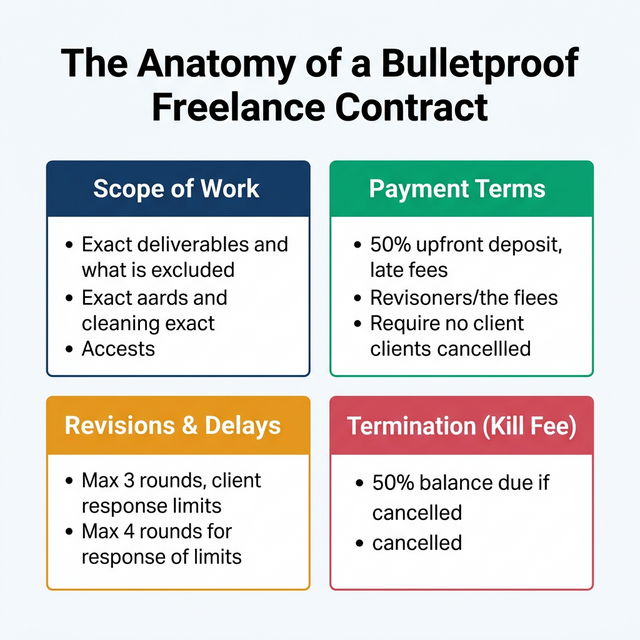
Quick Checklist: What you must include
- Scope of work - Exactly what you're delivering (and what you aren't)
- Payment terms - Amounts, due dates, deposits, and late fees
- Timeline & Delays - Deadlines and what happens if the client ghosts
- Revision limits - Exact number of included rounds
- Termination clause (Kill Fee) - How either party can end the contract
- Intellectual Property Rights - Work isn't theirs until it's paid in full
Why This Matters (The Data)
28%
of freelancers use a written contract for a given project (Freelancers Union survey of ~5,000 workers).
73%
fewer payment disputes for freelancers who use written contracts (Enty billing-data analysis).
71%
of small and medium businesses plan to increase freelance hiring (2026 Upwork Research Institute survey).
The uncomfortable pattern: clients who resist signing a contract are often the same ones who dispute scope and delay payment. Asking for a signature filters out problem clients before the work begins.
Why You Need a Contract (The $3,000 Lesson)
In 2019, a designer took on a branding project without a contract. The client seemed trustworthy, the project was straightforward, and they wanted to seem "flexible and easy to work with."
- Delivered logo concepts after 2 weeks
- Client loved them, asked for "just a few tweaks"
- Made the tweaks. Then they asked for "a couple more small changes"
- This went on for 6 weeks
- Finally delivered the final files. The client ghosted them and **never paid the $3,000**.
A contract would have prevented this by: Limiting revisions to 3 rounds in writing, requiring a 50% upfront deposit ($1,500 secured bare minimum), enforcing late fees, and giving them legal standing for small claims court.
Composite example based on common freelancer non-payment stories.
Always use a contract when:
- Any project over $500
- Working with a brand new client
- The project spans multiple weeks
- Creating work the client will legally own
- Scope could easily expand (web design, etc)
You might skip it when:
- Tiny project under $200 (still risky)
- Long-term client with proven payment history
- Very simple, one-time admin task
Is a Freelance Contract Legally Required?
In several US states, yes — for projects above a set value. As of 2025 and continuing into 2026, a written contract is required by state law for freelancers in:
California
Written contract required for projects of $250 or more, under freelance worker protection law.
New York
Written contract required for projects of $800 or more, under the Freelance Isn't Free Act.
Other cities and states have adopted similar "Freelance Isn't Free" protections, and more are following. Even where it isn't mandated, a written contract is your primary tool for enforcing payment. If a client won't sign, don't start the work.
On e-signatures: you don't need a printed, hand-signed document. Electronic signatures carry the same legal weight as handwritten ones in the US under the ESIGN Act (2000) and in the EU under eIDAS. A signed digital document includes a timestamp, IP address, and audit trail — often stronger evidence of intent than a scanned signature. Tools like DocuSign, HoneyBook, Bonsai, and PandaDoc all produce legally valid signed contracts.
This section is educational, not legal advice. For high-value contracts (generally over $25,000), complex IP terms, or regulated industries, consult a lawyer in your jurisdiction.
The 11 Sections Your Freelance Contract Must Have
Here is the exact clause-by-clause breakdown of a legally binding, bulletproof freelance contract.
Section 1: Parties & Date
Identifies who is legally bound, establishes when the agreement begins, and provides contact information. If the client is a company, use their legal name, not just a DBA.
Template Snippet
Between:
CLIENT:
[Client Full Name or Company Name]
[Address]
[Email]

FREELANCER:
[Your Full Name or Business Name]
[Address]
[Email]
Section 2: Scope of Work
The most important section. Prevents scope creep, defines when you're done, limits endless revision requests, and sets clear expectations.
Template Snippet
DELIVERABLES:
☐ [Specific deliverable 1 with details]
☐ [Specific deliverable 2 with details]

WHAT IS NOT INCLUDED:
✗ [Item specifically excluded 1]
✗ [Item specifically excluded 2]
Section 3: Payment Terms
Always require at least a 50% deposit before you start. Detail your schedule (e.g., 50/50 or 30/30/40), accepted payment methods, when invoices are due (Net 15 or 30), and specific late payment penalties (e.g., 5% per week).
Template Snippet
Payment Schedule:
- Deposit (50%): $[Amount] - Due upon signing
- Final payment (50%): $[Amount] - Due upon completion

Late Payments: Invoices not paid within [7] days of due date will incur a late fee of [5]% per week.
Section 4: Intellectual Property Rights
Clarifies who owns what. The key point: Ownership transfers ONLY after full payment. This is your leverage if they don't pay. Protects your portfolio rights and addresses third-party licensing.
Template Snippet
Upon receipt of FULL payment, all intellectual property rights to the final deliverables transfer to the Client.

Portfolio Rights: The Freelancer reserves the right to display completed work in portfolio...
Section 5: Revisions & Changes
Limits endless tweaking by defining exactly how many rounds are included and how much extra rounds cost. Requires a change order for work beyond original scope.
Template Snippet
Included Revisions: [2-3] rounds of revisions are included.
Additional Revisions: $[200] per round or $[Rate]/hour.

Scope Changes: Work beyond original scope will be quoted separately.
Section 6: Timeline & Delays
Client can't complain about delays they caused. Sets expectations for their responsibilities (e.g., providing feedback within 2 days). Protects you if they ghost for 3 weeks.
Template Snippet
Client Responsibilities:
- Provide required materials within [3] business days
- Respond to questions within [2] business days

Delays: If Client fails to provide materials... project timeline will be extended accordingly.
Section 7: Termination
Protects you if the client cancels halfway through. Ensures you're compensated for completed work (via a kill fee) and prevents the client from walking away with free work.
Template Snippet
By Client: Client may terminate this agreement with [7] days written notice. Upon termination:
- Client pays for all work completed to date
- Client pays [50]% of remaining balance as termination fee
- All payments made are non-refundable
Section 8: Confidentiality
Include this if the client shares sensitive business information, financials, customer data, or pre-launch products. If it's a simple public-facing project without sensitive data, you can skip it.
Template Snippet
Both parties agree to keep confidential any proprietary information shared during this engagement, including but not limited to:
- Business strategies
- Financial information
- Trade secrets
Section 9: Liability & Warranties
Limits how much you can be sued for (maximum = project fee). Clarifies you're not responsible for how they use your work after delivery, protecting you from unreasonable damages.
Template Snippet
Limitation of Liability:
Freelancer's total liability under this agreement shall not exceed the total project fee paid by Client.

Freelancer is not liable for indirect, incidental, or consequential damages.
Section 10: Dispute Resolution
Court is expensive. Mediation or Arbitration is cheaper and faster. This clause encourages settlement before anyone goes to court.
Template Snippet
1. Good Faith Negotiation
2. Mediation: If negotiation fails, disputes will go to mediation before legal action
3. Arbitration: Binding arbitration in [Your City, State]
Section 11: Signatures
To be binding, both parties must agree. Electronic signatures via DocuSign, typed names in email, or digital PDFs are fully legal under the ESIGN Act.
Template Snippet
By signing below, both parties agree to the terms...

CLIENT SIGNATURE:
Signature: _________________________

FREELANCER SIGNATURE:
Signature: _________________________
Bonus Clause for 2026: AI Usage
With AI tools now common in creative and technical work, clients increasingly want to know whether — and how — you use AI in deliverables, and some want to restrict it. Clarifying this upfront prevents disputes later: state whether AI tools are part of your process and who owns AI-assisted output. In 2026, this is quickly becoming one of the first clauses to negotiate, alongside payment and IP.
5 Critical Mistakes That Will Cost You Money
Vague Scope of Work
The Mistake
"Create marketing materials for client"
The Fix
Create: One 8.5x11" flyer, One email header, Three social graphics. NOT included: Web graphics, brochures.
Why: If it's not exhaustively listed as 'included' or 'excluded', you'll end up doing it for free.
No Revision Limits
The Mistake
"Includes revisions as needed"
The Fix
Includes 3 rounds of revisions (Round 1: Major structure, Round 2: Layout, Round 3: Polish). Additional rounds: $150 each.
Why: Without limits, picky clients can trap you in an infinite loop of 'just one more small tweak'.
No Payment Schedule or Due Dates
The Mistake
"Payment upon completion"
The Fix
50% ($2,500) due upon signing. 50% due within 15 days of final delivery. Late payments incur a 5% weekly fee.
Why: Give exact dates, percentages, and consequences for missing them.
Transferring IP Rights Before Payment
The Mistake
"Client owns all work upon delivery"
The Fix
Upon receipt of FULL payment, all rights transfer to Client. Until full payment is received, Freelancer retains all ownership.
Why: If you give up rights before they pay, you lose your only leverage to collect the final invoice.
No Kill Fee for Cancellations
The Mistake
(No termination clause included)
The Fix
If Client terminates: Pay for work completed to date AND pay 50% of the remaining project balance as a kill fee. Deposits are non-refundable.
Why: Clients will cancel halfway through a project. Make sure you don't lose that income.
How to Enforce Your Contract (When Clients Break It)
A contract is only useful if you enforce it. Here's exactly what to do when clients violate the boundaries you set up.
Client Stops Responding
The Problem: You sent the drafts 3 weeks ago and they ghosted.
"If Client fails to respond within [X] days, Freelancer may consider project abandoned and retain all payments."
Your Script/Action:
1) Reminder day 3, 2) Reminder day 7, 3) Final notice day 14 saying you'll close the project and retain the non-refundable deposit. Close it.
Infinite Revisions
The Problem: They are on round 6 of 'small tweaks'.
"Includes 3 revision rounds. Additional revisions: $200/round."
Your Script/Action:
"Hi [Name], we've finished our 3 included rounds. I'm happy to do Round 4 for $200, or we can call it complete as-is. Which do you prefer?"
Late Payments
The Problem: Invoice is 2 weeks overdue.
"Late payments incur 5% fee per week after due date."
Your Script/Action:
"Hi [Name], invoice is 2 weeks late with 10% fees totaling $[Total]. If payment isn't received by [Date], I will pause ongoing work and refer this to collections."
Scope Creep
The Problem: They casually ask you to 'also write the copy'.
"Work beyond original scope requires a separate change order and approval before work begins."
Your Script/Action:
"I can definitely add that! Since it's outside our original scope, here is a change order for the copy: Additional Cost $X, Extended timeline +X days. Reply 'Approved' to proceed."
Freelance Contract Templates by Profession
The core clauses stay the same, but each field has specifics worth customizing. Here's what matters most for the most common freelance professions — the free contract template gives you the structure; adjust the scope and deliverables for your work.
Freelance Writer Contract
- Deliverable specifics: word count, number of articles, topic, and format
- Revisions: how many rounds, and what counts as a revision vs. a full rewrite
- Ownership & bylines: portfolio rights, and whether the work is ghostwritten
- Kill fee: critical for writers, since research and drafting happen up front
- Usage rights: where the content can be published and whether rights are exclusive
Graphic Design Contract
- Number of concepts and revision rounds (design is where “one more version” spirals)
- File formats: source files vs. flattened exports — source files often cost extra
- IP transfers on final payment — you own the designs until paid in full
- Usage scope: print, digital, merchandise, resale — each carries different value
- Kill fee: protects concept work if the client cancels after seeing directions
Freelance Artist Contract
- Clear commission terms: subject, size, medium, and style
- Usage & licensing: personal vs. commercial vs. resale rights — price each separately
- Reproduction rights: prints, merchandise, or derivatives
- Milestone payments: sketch approval → line art → final, with payment at each stage
- Portfolio rights: your right to display the commissioned work
Videographer Contract
- Deliverables: final runtime, number of videos, resolution, formats, and raw footage (usually excluded or priced separately)
- Payment: 50% deposit → 25% at first draft → 25% before final files is standard
- Revision limits: video revisions are time-intensive, so cap them clearly
- Usage rights: platforms, license duration, and exclusivity
- Kill fee: shoots involve significant upfront time and non-refundable costs
Freelance vs Contract: What's the Difference?
A common point of confusion: what's the actual difference between freelance and contract work? Here's the clear answer.
Freelancer
Self-employed, typically works with multiple clients at once, sets their own rates and hours, uses their own equipment, and controls how the work gets done. A business owner who receives a 1099 and handles their own taxes.
Contractor
Often engaged for a specific duration or defined project, sometimes through an agency, frequently working with one client at a time and occasionally on the client's schedule. Contract roles can be longer-term and more embedded than typical freelance gigs.
The overlap: both are non-employees, both handle their own taxes, and — legally — freelancers are a type of independent contractor. The line is genuinely blurry, and many people use the terms interchangeably. The practical difference: "freelance" implies multiple clients and full autonomy, while "contract" implies a defined term or a single primary client.
The key takeaway: whichever label fits, you need a written contract to protect your payment, scope, and rights. Working without a signed agreement is the real risk — not which term you put on your invoice.
A contract is one piece of running a professional freelance business. Set your number first with the free freelance rate calculator, bill it with the free invoice generator, and win the work that precedes the contract with these cold email templates and a winning proposal. Looking for clients worth contracting? Contra is a commission-free platform where you keep 100% of what you earn.
Download the Complete Freelance Contract Template
Make $1,000 in Your First 30 Days as a Freelancer.
The exact day-by-day system to land premium clients. Includes proposal templates, pricing formulas, and word-for-word scripts.
$49 $29 — save $20
Freelance Contract FAQ
Related Tools & Resources
Legal Disclaimer: This article provides general information and is not formal legal advice. Contract requirements vary by location. Use your best judgment and consult a lawyer in your jurisdiction for specific legal guidance.